
What Happens If a Scholar Drops Out or Changes Course Mid-Year?
Most donor FAQs cover eligibility, tax deductibility, and how to give. Almost none of them answer a question that any careful donor should actually want answered: what happens if the student doesn’t finish? People change course, families relocate, health issues happen, a student switches from engineering to something else entirely. If you’re funding four years of someone’s education, it’s fair to ask what happens to that commitment if year two doesn’t go as planned.
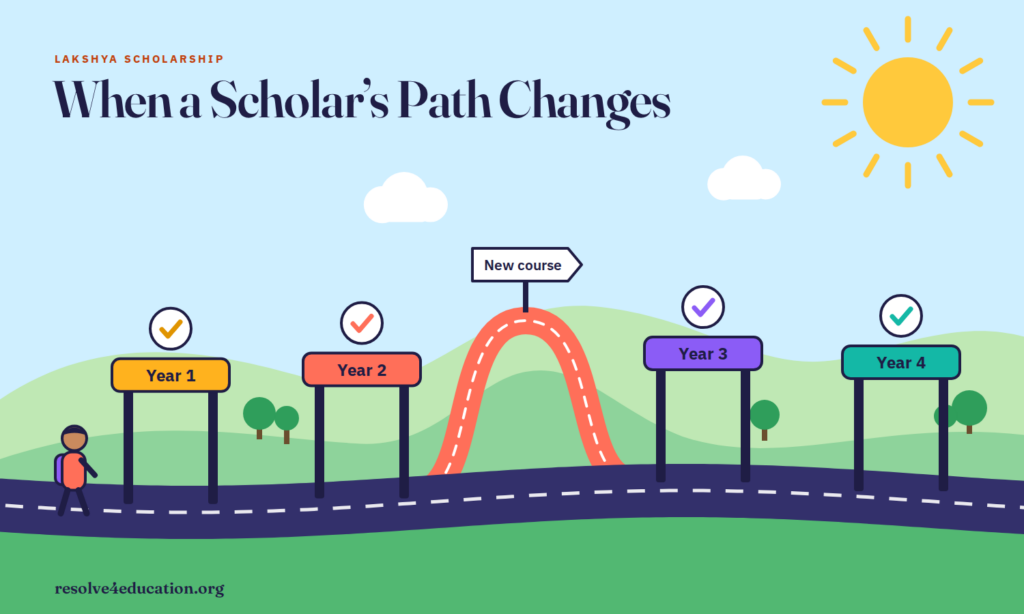
The first thing to understand is that a Lakshya Scholarship award isn’t a single four-year check handed over on day one. It’s structured as an annually renewable commitment, for up to four years, with real conditions attached to each renewal. Every year, to continue receiving support, a scholar has to remain continuously enrolled, comply with the program’s terms, maintain at least 65% academic performance (or the equivalent under their specific program’s grading system), and submit an official transcript for review. If a student doesn’t meet that bar in a given year, the scholarship for the following year isn’t automatically renewed.
This structure exists precisely for situations like a course change, an academic struggle, or a student stepping away from their studies: it means Shiksha Sankalp Society isn’t obligated to keep funding a student who’s no longer enrolled or no longer meeting the program’s basic academic expectations, because the commitment is re-evaluated every year rather than locked in permanently at the start.
One thing the program is explicit about: scholars are never expected to repay the scholarship money, regardless of how their education plays out. The site frames the only expected ‘return’ as scholars paying it forward when and if they’re able to — through mentorship, volunteering, or their own future giving, not a financial repayment obligation.
So if a student’s path changes, the scholarship isn’t treated as a loan gone unpaid; it’s treated as support that was given for the time the student was actually enrolled and progressing.
It’s worth separating two different scenarios that are easy to conflate. A student switching from one undergraduate degree to another, while remaining a full-time student at an eligible institution and continuing to meet the academic bar, is a different situation from a student withdrawing from higher education altogether.
A student switching from one undergraduate degree to another, while remaining a full-time student at an eligible institution and continuing to meet the academic bar.
A student withdrawing from higher education altogether.
The published renewal criteria are about continuous enrollment and academic performance generally, not about staying in one specific, named course of study — so a genuine change of course, handled honestly and disclosed at the annual review, is a very different case from simply dropping out.
Practically, this means your gift isn’t an all-or-nothing four-year bet on one specific outcome. It’s a year of support, renewed based on real conditions, for as long as the student stays enrolled and keeps meeting the bar the program sets.
If a student’s circumstances change in a way that ends their enrollment, the annual-renewal structure is what protects your gift’s intent — support that was given is not clawed back or treated as wasted, but support that hasn’t yet been given isn’t released on autopilot to a student who’s no longer in school either.
The annual renewal structure means scholarship support is reviewed as a scholar’s education progresses. A change in circumstances does not turn the scholarship into a loan, while continued support remains tied to enrollment and the program’s renewal requirements.